JC Restoration Chatham Township
📞 862-421-8892
24/7 Emergency Response

Water Damage Restoration in Chatham Township, NJ — One Contract, One Phone Number.

Property restoration based in Chatham Township, NJ. Morris County coverage. 24/7 emergency dispatch, IICRC-standard methodology, single-source mitigation through reconstruction.

Local team in Chatham Township Honest, transparent pricing 24/7 emergency line
NJ-Built Working Morris County losses
Documented Drying Calibrated meters, baseline-to-baseline
No-AOB You keep your insurance claim rights
Emergency Restoration

What Our Chatham Township Team Does for Morris County.

Water Damage Restoration

24/7

IICRC S500 protocol applied to every Morris County water loss — Cat-1 supply line through Cat-3 storm intrusion, with reconstruction by the same crew.

  • 24/7 emergency dispatch
  • Truck-mounted extraction
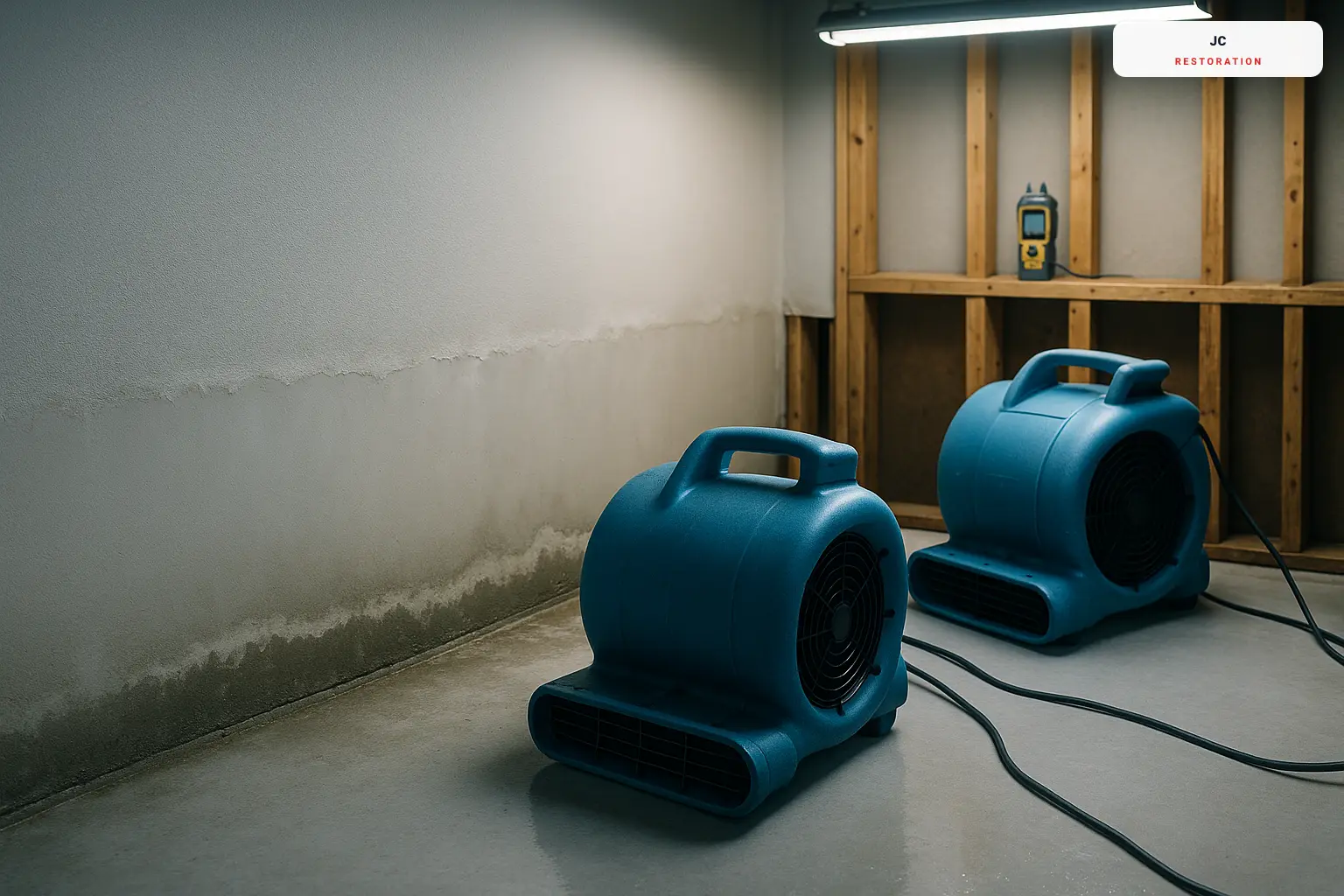
  • Industrial drying equipment
Learn more

Fire Damage Restoration

24/7

Kitchen flare-ups through full structure fires — restoration scope built around what is salvageable vs what insurance will replace.

  • Soot + smoke odor removal
  • HVAC decontamination
  • Pack-out + content cleaning
Learn more

Storm Damage Restoration

24/7

Storm losses run different timelines than pipe bursts. We sequence the response: stabilize, dry, mold-prevent, then rebuild — without losing the carrier scope.

  • Emergency board-up + tarping
  • Wind-driven rain water extraction
  • Roof + envelope repair
Learn more

Mold Remediation

Mold prevention done DURING drying instead of remediation done AFTER — applied to every water loss we mitigate.

  • IICRC S520 protocol
  • Negative-air containment
  • HEPA filtration
Learn more

Sewage Cleanup

24/7

Sewage backup in Chatham Township requires Cat-3 protocol — porous materials out, hard surfaces decontaminated, structure dried under containment.

  • IICRC S500 Cat-3 protocol
  • Full Tyvek + HEPA respirator PPE
  • Porous-material removal to flood line
Learn more

Reconstruction

Reconstruction in Morris County done with materials matched to pre-loss spec, so insurance pays out at like-kind-and-quality value.

  • Drywall replacement + finish
  • Hardwood, LVP, tile, carpet flooring
  • Cabinetry + trim work
Learn more
24/7 Emergency

24/7 emergency response across Morris County. Real human, real truck, real fast.

We dispatch a tech 24/7 across the Chatham Township metro. Average on-site time is under an hour.

Call 862-421-8892
The difference

Why Customers Choose Us

Real reasons. No invented stats, no manufactured awards.

  • 01

    Real Chatham Township Dispatch

    Phone answered by a human in NJ 24/7. No automated phone tree, no offshore call-center, no callback after the loss has gotten worse. Truck rolls while you are still on the call.

  • 02

    Insurance Documentation Discipline

    Photos, moisture readings on a building diagram, Xactimate scope at carrier-standard pricing, equipment runtime logs. The full record goes to the adjuster so the claim closes without back-and-forth.

  • 03

    Single-Source Contracting

    Same crew handles mitigation AND reconstruction. No handoff to a separate general contractor mid-job. One contract, one phone number, one team accountable from first call to final walkthrough.

Local Guide

Chatham Township Restoration — What You Need to Know

Property restoration based in Chatham Township, NJ. Morris County coverage. 24/7 emergency dispatch, IICRC-standard methodology, single-source mitigation through reconstruction.

Insurance Carriers, Claim Cycles, and What Speed Actually Costs

The NJ insurance market is dominated by a handful of carriers — NJM, Travelers, State Farm, Allstate, Liberty Mutual on the residential side; CNA, Hartford, Liberty Mutual, Travelers on the commercial side; Chubb, AIG Private Client, PURE on the high-end personal lines. Our scope formats and documentation packages match what those specific adjusters expect to see. That match is what produces fast claim cycles.

What speed actually costs the homeowner: nothing. Faster claim cycles benefit the homeowner directly because mitigation can proceed without waiting for adjuster approval at every stage, reconstruction starts sooner, displaced family members return home faster, and the loss-of-use coverage runs for a shorter period. Slower claim cycles — the kind generated by sloppy documentation or contractor-adjuster disagreements — extend the entire timeline at the homeowner's cost.

What speed actually costs the contractor: nothing either. Faster claim cycles let us redeploy crew capacity to the next job sooner. Adjusters who recognize our scopes call us first on overflow work because they know the back-and-forth will be minimal. The investment in documentation discipline pays for itself in claim cycle time — for our clients, our crew, and the carrier.

Restoration Service Across Chatham Township, Madison, Chatham Borough, Florham Park, and the Morris County Footprint

From our Chatham Township base we serve a tight radius across Morris County and the immediately surrounding municipalities. Standard arrival times: Chatham Township addresses inside the hour during normal traffic; Madison, Chatham Borough, Florham Park, and Summit typically reach in 20-40 minutes. Outside that footprint we will tell you honestly whether we can be there fast enough to be useful, or whether you should call somebody closer.

What our Morris County clients see most often: residential water losses (sump pump failures, supply line bursts, water heater leaks, dishwasher and washing machine appliance failures), storm-related events (nor'easter wind damage, tropical-storm-remnant flooding, frozen-pipe winter bursts), fire and smoke restoration (kitchen fires being the dominant pattern), sewer backup (combined-sewer territory in older parts of Morris County), and chronic-moisture mold problems usually discovered during home renovation or sale inspection.

The NJ housing stock varies widely — from 1920s plaster-walled bungalows to 1950s suburban tract construction to 2000s townhouse + condo development. Each calls for a slightly different restoration approach. Our crew works the Morris County housing patterns regularly enough that we recognize what's behind a wall before we open it.

Why Documentation Matters More Than People Think

The single biggest accelerator on a residential restoration claim is whether the scope arrives in a format the adjuster can settle without a callback. Sounds like a small thing. It isn't — it's the difference between a claim that closes in 2 weeks and one that drags through 3 rounds of supplements over 3 months.

Our standard documentation package on every Chatham Township job: photos of every wet surface before equipment goes down, moisture readings logged on a building diagram (so the adjuster sees WHERE the readings were taken, not just the numbers), Xactimate scope at carrier-standard pricing for the NJ market with line items tied to IICRC S500 protocols, equipment runtime logs (air movers + dehumidifiers, hours each), final clearance moisture readings showing every wet substrate returned to baseline.

This documentation is what makes the difference between scopes that close cleanly and scopes that get challenged. Adjusters who see clean documentation regularly come to recognize the source and approve faster. Adjusters who see vague or incomplete scopes push back, request supplements, and slow the entire project. We invested in the documentation discipline because the carrier relationship is what determines whether we can keep doing this work at scale — short-cuts on documentation hurt the claim AND the next claim AND the one after.

Water Damage, Fire Restoration, Mold Remediation, and Sewage Cleanup in Chatham Township, Nj

Our Chatham Township crew handles the full property restoration scope: water damage from pipe failures and storm events, fire and smoke damage with full content cleaning and HVAC decontamination, mold remediation per IICRC S520, sewage cleanup with full Cat-3 protocol, and the reconstruction work that follows each. Same crew handles mitigation through reconstruction — no handoff to a separate contractor mid-project.

Most calls fall into one of these patterns: residential water loss from a pipe burst or appliance failure (most common), storm-related water intrusion through a damaged building envelope, sewer backup in a basement (combined-sewer territory in older NJ towns), kitchen or chimney fire smoke damage, and chronic-moisture mold growth that's been building behind walls for months. Each has its own protocol, its own equipment requirements, its own insurance treatment. We are equipped for all of them on every dispatch.

For multi-unit properties — condos, townhouses, commercial — we add the coordination layer: per-unit Xactimate scopes, building-management communication, COIs on file, after-hours noise scheduling. For single-family residential we keep it simple: clear scope, daily updates, single contract from first call to final walkthrough.

What the First Hour of a Property Loss Actually Looks Like

The first hour after a property loss is the highest-leverage time on the entire job. Most of the eventual claim cost is decided not by the loss itself, but by what happens (or doesn't happen) in the first 60 minutes. From Chatham Township dispatch our standard target is on-site within the hour, and the protocol once we arrive is built around capturing those high-leverage minutes.

What we do on arrival, in this order: confirm the source is fully off, assess loss category per IICRC S500, photograph every wet surface before equipment goes down, take initial moisture readings on each substrate, write the cause-of-loss narrative for the insurance claim. Only after that does the actual extraction equipment go to work. The sequence matters because the documentation that gets written in the first hour is what determines how the rest of the project goes — both technically and financially.

What clients sometimes try to do before we arrive (and what we ask them not to): lifting wet drywall (it crumbles and complicates demo), running heaters (drives moisture deeper into materials), throwing damaged contents away (becomes unprovable losses), signing AOB paperwork from contractors who arrive unsolicited. The 30-60 minutes between your call and our arrival are best spent moving valuables out of the cascade path and photographing the loss for insurance.

Process

How It Works

  1. 01

    Phone Triage

    Real human dispatch from Chatham Township. We sort loss type on the first call so the truck arrives equipped for what we are walking into.

  2. 02

    On-site Assessment

    Photos of every wet surface, moisture readings of every substrate, written cause-of-loss narrative, confirmation the source is fully off.

  3. 03

    Containment + Extraction

    Standing water removed first. Affected areas isolated to prevent spread. Damaged porous material cut to documented flood line and bagged for disposal.

  4. 04

    Documented Drying

    Industrial drying equipment sized for the loss volume. Daily moisture readings logged on a building diagram. Equipment runtime tracked for the insurance claim.

  5. 05

    Reconstruction + Walkthrough

    Drywall, flooring, paint, trim — all matched to pre-loss condition. Final walkthrough confirms the work is done before the project closes.

Service Area

Serving Morris County

Our Chatham Township crew dispatches across Morris County reaching Madison, Chatham Borough, Florham Park, and Summit typically in 20-40 minutes. Outside that footprint? Call us anyway — we will tell you straight whether we can be there fast enough to be useful or whether you should call somebody closer.

Counties Covered

  • Morris County, NJ

Cities We Service

Each Morris city below opens a local page with arrival times from our Chatham Township base and the loss patterns we handle most often in that municipality.

Not sure if you're in our area? Call 862-421-8892 and we'll tell you in 30 seconds.
FAQ

Frequently Asked Questions

If you don't see your question, just call or message us.

How do you make sure mold does not come back? +

Mold prevention happens during drying, not after. We hold the structure under controlled airflow until moisture meters confirm wood, drywall, and substrate are back inside the manufacturer-approved dry range. Anything porous that absorbed contaminated water comes out. Surfaces receive a registered antimicrobial before reconstruction. We also pull access panels and inspect HVAC ductwork if water tracked into the system.

Will my floors and walls have to come out? +

Often less than people expect. Category-1 (clean supply-line) water that we reach inside 24-48 hours can usually be dried in place. Category-3 (sewage, river, ground intrusion) is different — IICRC S500 protocol requires removing porous materials those waters contacted. We cut to a documented flood line and replace what comes out.

How long does drying take after a water loss? +

Three to five days for a typical residential water loss. Hardwood floors and dense materials can take longer — sometimes 7-10 days. We monitor with calibrated moisture meters daily and only stop drying when readings return to dry-standard moisture content for the materials in your home.

Do you work directly with my insurance company? +

Yes, with your authorization. We work with NJM, State Farm, Allstate, Liberty Mutual, Travelers, Progressive, and most other carriers serving NJ. Get the claim number from your carrier first if you can; with that we can talk to your adjuster directly and bill the carrier rather than you.

How fast can you respond to an emergency in Chatham Township? +

For active emergencies in Chatham Township, our standard target is on-site within the hour during normal traffic conditions. We dispatch 24/7 — a real human answers the phone, gets the address and loss type, and a truck rolls while we are still on the call with you.

What happens to my contents during restoration? +

For minor losses, we move content within the home to dry/safe areas and clean as needed. For significant losses, we offer pack-out service — your contents are catalogued, transported to our cleaning facility, sorted by material type, cleaned appropriately, and stored climate-controlled until the property is ready for re-occupancy. Pack-out keeps possessions out of the affected environment so they stop absorbing additional damage.

How do you handle pets and kids during the work? +

For most water restoration work, pets and kids stay in unaffected areas of the home and life continues. We coordinate access timing so equipment doesn't prevent normal household routines. For Cat-3 sewage cleanup, the affected area is evacuated during the cleanup phase (typically 5-7 days) — we discuss temporary arrangements at our first on-site visit.

Call Now • Chatham Township

Need Restoration in Chatham Township? One Call Gets a Crew Moving.

One phone call gets a truck rolling. Real Chatham Township team, real local response time, no automated phone tree. We'll be on site fast.

📞 Tap To Call 862-421-8892

24/7 Emergency Dispatch

📞 Call 862-421-8892